
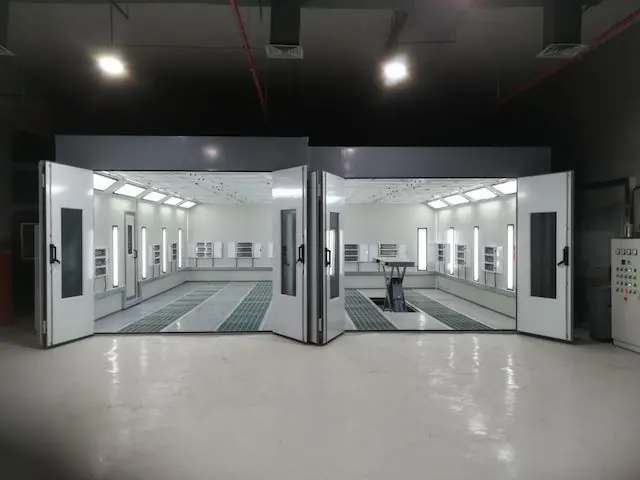
A spray booth is a long-term purchase that sets how fast your paint shop works and how good the finish is. These are the decisions that matter, roughly in the order we work through them with customers.
1. Start with the largest item you paint
Measure the largest item you will put in the booth, whether that is a fabricated frame, a machine, a vehicle or a batch of parts on a trolley, then add working space. Allow about a metre on each side and at each end so the painter can walk around it, and more if the item arrives on a forklift, trolley or crane. Our standard booth is 6 900 × 3 900 mm inside.
Height is easy to underestimate. A standard booth is about 2.7 m high, which suits most parts and light vehicles. Tall machines, skid-mounted equipment, tractors and high-roof vehicles need more height so the painter can hold the gun at the right angle over the top. That is what the TS 5 Jumbo is for. For trucks, buses and mining machines, go straight to a TS 6.
2. Choose the airflow pattern
Cross draft: air enters at the doors and leaves through filters in the back wall. It is the simplest and most affordable layout, and works well for industrial parts, primers and enamels. Our TS 1 is a cross-draft booth.
Downdraft: air enters through a filtered ceiling and leaves through floor grids. Overspray is pulled down and away from the surface, which gives a cleaner finish. Choose downdraft where finish quality matters most. Our TS 2 to TS 5 are downdraft booths on a raised base, so you do not need a pit.
Downdraft with side extraction: on very long booths we bring filtered air down from the ceiling and extract at the sides, which avoids a pit under a 15 or 20 m booth.
3. Decide on heating and curing
Heating does two jobs: it keeps the booth at a steady temperature while you spray, and it bakes the paint afterwards so the job can leave sooner. In South Africa diesel burners are the most common because diesel is available everywhere. Gas works where you have a supply. Infrared heats the paint film directly and cures fastest, but needs a much larger electrical supply. Electric heating suits sites without diesel or gas, provided the electrical supply is large enough. We offer all four.
If you only spray primers or industrial enamels in a warm area, you may not need heating at first. A TS 1 can have heating added later.
4. Look at the filtration
Air is filtered on the way in, to keep dust off wet paint, and on the way out, to catch overspray before it leaves the building. Entry-level booths use two stages. Our TS 3 uses four. More stages mean cleaner paint and cleaner exhaust. See spray booth filters explained.
5. Don't skimp on light
Painters match colour and judge texture by eye. Ceiling lights alone leave the lower half and undersides of an item in shadow. Wall lights at low level fix that. Our TS 3 layout gives about 1 100 lux at working height.
6. Solvent or water-based paint?
Water-based coatings need moving air to flash off between coats. If you use them, or plan to, choose a TS 4 with drying units, or make sure your booth can take a waterborne upgrade.
7. Check the building and services
- Floor: a level floor or slab. Raised-base booths need no pit.
- Height: room above the booth for the ceiling plenum, and a route for exhaust stacks through the roof or wall.
- Side space: about 1.5 m beside the booth for the air unit on most models.
- Power: a 380 V, three-phase supply. A standard heated booth draws roughly 7 to 16.5 kW, large booths much more.
- Access: how the booth panels and air unit will get into the building.
8. Fire safety and approvals
Spray booths are subject to municipal fire safety by-laws, and many local authorities and insurers want to see the booth's details before it is used. We design to meet these requirements, with flame-proof motors and fire dampers where needed, and we can provide drawings and specifications for your approval process. Check with your local fire department early.
9. Think about the whole paint shop
A booth only stays productive if work arrives ready to paint. Preparation bays keep sanding dust out of the booth, and a mixing room keeps paint and thinners out of the workshop. If you are planning from scratch, consider a turnkey paint shop.
10. Ask about after-sales
Ask who will service the booth, how quickly they can get to you, and whether filters and burner parts are kept in stock. We service every make of booth, and include operator training with every installation.