
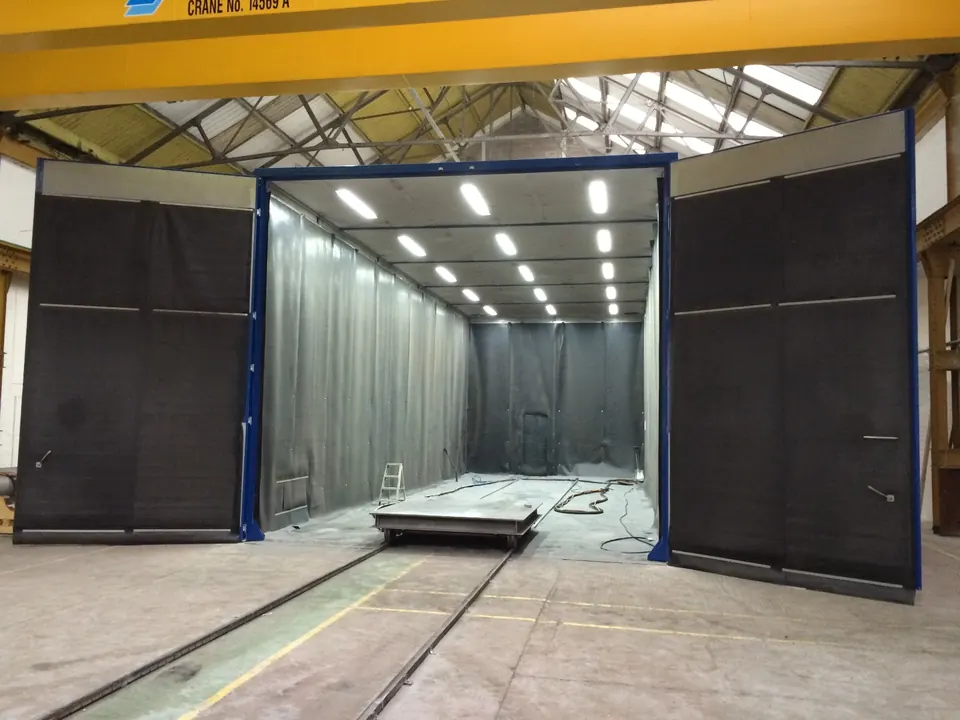
A shot blast booth is more than a room. It is a system that has to contain the abrasive, keep the air clear enough for the blaster to see, recover and clean the abrasive for reuse, and protect the operator. These are the parts to plan.
1. The booth
Size the booth around the largest item you blast, plus room for the blaster to work all round it, usually at least a metre. Walls must stand up to rebound abrasive: rubber-lined panels, steel plate or converted shipping containers are common, depending on size and budget. Plan the doors around how work comes in, whether by forklift, crane or rail trolley.
2. Lighting
Blasting raises a cloud of dust, so the booth needs strong, protected lighting, mounted behind impact-resistant covers so rebound abrasive does not destroy it. Good light means a more even surface profile and fewer missed areas.
3. Extraction: the dust collector
The dust collector pulls dusty air out of the booth so the blaster can see, and filters it before it is released. It is sized on the air volume needed to keep a steady air speed across the booth, which depends on the booth's cross-section and layout. Cartridge dust collectors with reverse-pulse cleaning are the usual choice. An undersized collector is the most common reason blast rooms are dusty and slow.
4. Ducting
Ducting connects the booth to the dust collector. It must be sized to keep dust moving without settling, and built heavy enough to resist abrasion at bends. See our ducting page.
5. Shot reclamation
Steel shot and grit can be reused many times if they are recovered and cleaned. Options range from manual sweep-in hoppers, through partial floor recovery, to full-floor scraper or screw-conveyor systems. A separator removes dust and fines so only reusable abrasive goes back to the blast pot. The right level of recovery depends on how many hours a day you blast.
6. Shot pots and blasting equipment
The blast pot, hose, nozzle and remote controls set the production rate. Nozzle size and the air supply from your compressor have to be matched: a larger nozzle blasts faster but needs more air.
7. PPE and breathing air
Blasters need a supplied-air blast helmet, a breathing air filter, a blast suit, gloves and hearing protection. Avoid silica sand as an abrasive: respirable crystalline silica is a serious health hazard and is regulated under the Regulations for Hazardous Chemical Agents.
One supplier for the whole system
We supply the shot blast booth with lighting, the dust collector, ducting, shot reclamation, shot pots and blasting equipment, and PPE, either as a complete system or just the parts you need. Tell us what you blast.